The Flames of Me
Je m'appelle Daniel
Daniel Léger
2026
| 10 min 02 s
Animation – fumage technique (drawing using soot from a flame)
English version
A National Film Board of Canada production
How do you rebuild your sense of self after being diagnosed with bipolar disorder? Daniel Léger experienced his first manic episode in his early thirties. With courage and vulnerability, he recounts how his diagnosis shook his identity to the core. Through striking images created with fire and soot by visual artist Steven Spazuk, the film depicts Léger’s personality in rich nuances of shadow and light. The transformations paint a sensitive portrait of a man who, despite his mental health struggles, has been able to rise from the ashes.
How do you rebuild your sense of self after being diagnosed with bipolar disorder? Acadian filmmaker Daniel Léger teams up with visual artist Steven Spazuk to tell a riveting story of shadow and light in this animated short film—the first to use the “fumage” technique.
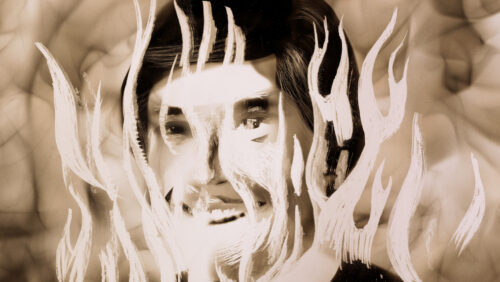
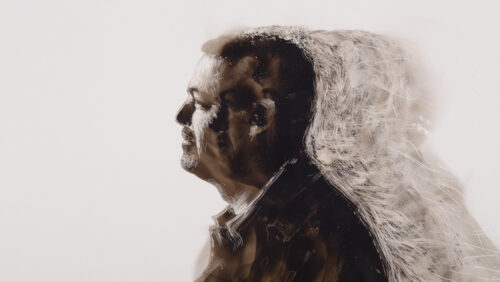
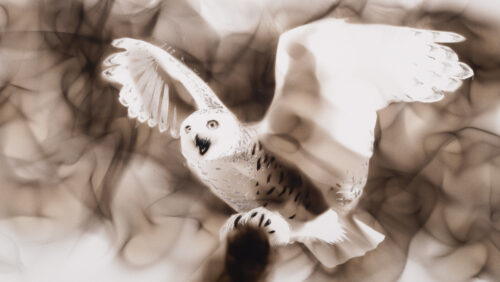
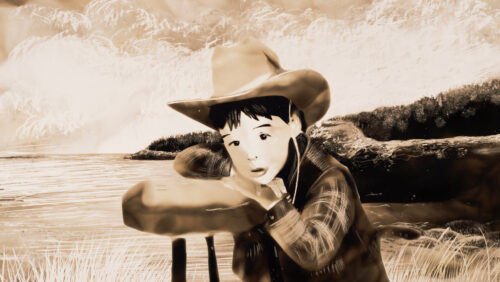
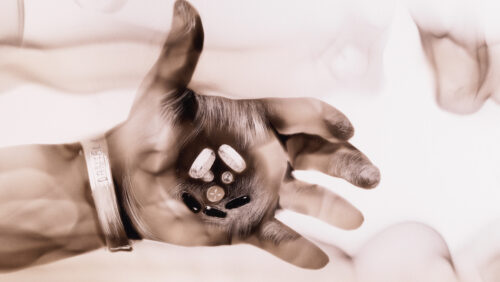
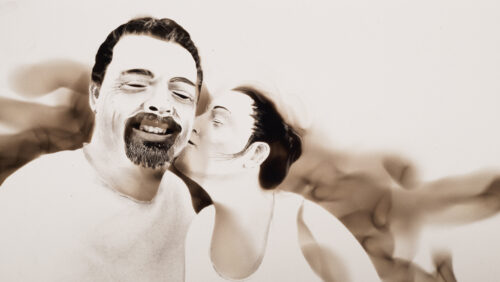
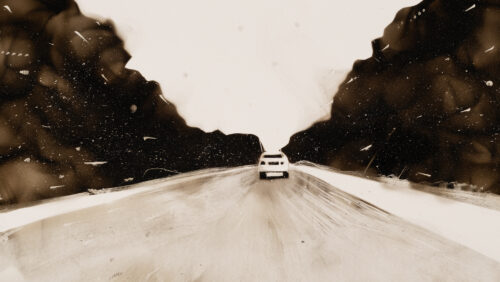
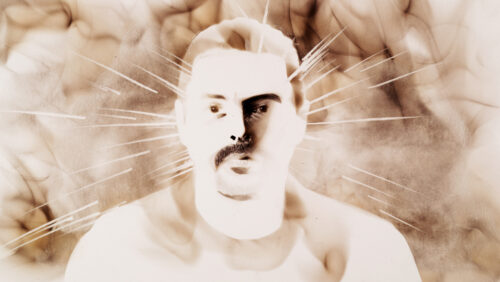
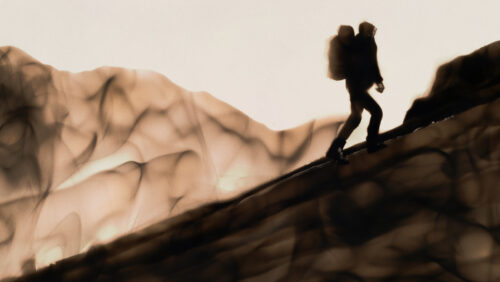
A long-time seeker of meaning and adventure, Léger experienced his first manic episode in his early thirties. He was committed to a psychiatric hospital and diagnosed with bipolar disorder, shattering his sense of identity. Narrated in the first person with disarming vulnerability, The Flames of Me is an autobiographical account that’s depicted using Spazuk’s strikingly dynamic images, painted with fire. As if by magic, a candle flame deposits a layer of soot on cardstock, which the artist then scrapes away using various implements to bring out different shapes and light. The swirls of light and dark grey give form to facets of Léger’s personality that are both projections of the imagination and sources of fear. In thousands of ever-changing images, a king morphs into a demon, then becomes a lion or a snowy owl, then disappears into smoke to be reborn from the ashes. This sensitive and courageous self-portrait reminds us that identity transcends mental health struggles and that the path back to self is through love.
ONE-LINERS
#1
Created with fire and soot, this animated short recounts one man’s journey through shadow and light after being diagnosed with bipolar disorder in his thirties.
#2
The first animated film to be drawn using flames, this courageous self-portrait reminds us that no one is defined solely by their dark side.
DESCRIPTION OF ANIMATION TECHNIQUE
“Fumage” is an artistic technique developed in the 1930s by surrealist painter Wolfgang Paalen. It consists of moving a candle flame close to a surface (cardstock, paper or freshly painted canvas) to deposit a layer of soot. The smoke gives rise to random shapes and shades of grey. The artist then uses various implements, such as precision knife blades, brushes or feathers, to define edges, brighten certain areas or shape textures. With an artistic lineage that can be traced to surrealist experimentation and automatic drawing, the technique blends chance, intuition and technical skill.
Bipolar disorder
Bipolar disorder, formerly called “manic depression,” is a mood disorder characterized by swings between manic episodes (periods of high energy, euphoria or excessive irritability) and episodes of severe depression.1
About 3% of Canadians will suffer from a bipolar disorder during their lifetimes.2
With suitable care—usually a combination of medication and psychosocial intervention—people with bipolar disorder can control their symptoms and lead fulfilling lives.3 According to a recent study, 43% of people with bipolar disorder in Canada were symptom-free, and about one in four people (23.5%) achieve complete mental health.4
—-
1 : World Health Organization
2 : Health Canada
3 : World Health Organization
4 : University of Toronto
CANADIAN MENTAL HEALTH RESOURCES
Mood Disorders Society of Canada: What is Bipolar Disorder?, Find help by province and territory, Discussion forum
Canadian Mental Health Association: How to get help, Helping others
Bipolar Wellness Center: Online resource for self-managing bipolar disorder
Relief (French only): Living with bipolar disorder, Regional resources
Interview with filmmaker Daniel Léger
How would you sum up this film?
The Flames of Me is about my search for identity. I was born under the weight of beliefs and labels, some that I placed on myself and others that were imposed on me, the most significant of which was bipolar disorder. As painful as it’s been transformative, the disorder led me to explore my innermost self in search of meaning, wholeness and light.
In this animated film, which was illustrated by artist Steven Spazuk using soot, interspersed with real footage of my manic periods, I discover that I’m neither merely a diagnosis nor an identity set in stone. I’m much more than that. I’m undergoing constant transformation, connected to all living things, to everything that exists.
The Flames of Me is a personal voyage through shadow and light—the story of a man who learns to stop defining himself and instead sees himself as one flame in the great fire of consciousness.
Why did you want to tell your story through an animated film drawn using soot?
Fire is bipolar: it’s both destructive and luminous. The label of bipolarity is the flame—unstable and ever changing.
But I am the fire itself: the flames represent my various identities, thoughts and emotions, all emanating from a single source.
The smoke represents doubt, memory, passage—my story and the story of my ancestors. In discovering that the fire is essentially love, the true medicine of souls, I’m reborn from the ashes, like a phoenix.
Your film conveys both the darkness and the light that comes with being diagnosed with a mental illness later in life. What do you want audiences to take away from the film?
I want audiences to understand that we’re not merely the diagnoses or labels that people put on us. Defining yourself that way is limiting and harmful, and it reduces you to a single facet.
By taking a step back from the illness, you gain a sort of inner freedom. That perspective allows you to transform the illness into a tool of self-knowledge and personal growth rather than a burden.
I also want the film to help demystify mental health; to make it something we can talk about without shame or taboos but with kindness, openness and humanity instead.
Tell us about your first experience making an animated film and your partnership with artist Steven Spazuk.
This animated film project was the most beautiful creative experience of my life. It was so much more than an artistic process; it was a healing process. The film transformed me. It helped me shrug off the labels and recognize that I’m a whole person who isn’t defined by my identities.
Because we were also using a technique that had never before been used in animation, there were many challenges. But every obstacle became an opportunity to invent, experiment and refine our approach.
Working with Steven Spazuk was a huge privilege—the most wonderful partnership of my life. In six years working together, there wasn’t a single disagreement; we created together in perfect harmony. Every day, Steven sent me pictures of his soot drawings. We talked about them, thought things over and adapted together. We reworked the animatic several times because the story changed as the film moved forward. Nothing was set in stone. Everything was alive and volatile—like fire.
Steven drew on his 25 years of experience with “fumage”—using soot as a medium—and also on my video footage and my reenactments to give the film a deeply human dimension. He explored various methods, such as rotoscoping, stencilling, soot prints, fire marks and scraping. Each drawing was an embodiment of the project’s spirit.
Steven is an outstanding artist, a shining light and a dear friend. It took six years and over 4,000 drawings—4 to 8 per day—to create a film that’s less than 10 minutes long. The epitome of patience, love and humanity.
What was the most rewarding part of making this film?
It was the personal transformation the film allowed me to experience. In telling my story, I had to look myself in the eye, accept my weaknesses and transform pain into light. The film reconciled me with myself.
Creating The Flames of Me also helped me understand the strength of the collective. Working with Steven Spazuk and the NFB team was a deeply human experience. Together, we were able to transform something as personal as bipolar disorder into a broadly appealing work of art.
To see how vulnerability could give rise to beauty, meaning and maybe a bit of hope for others—that was the most rewarding thing for me.
You’ve made several documentaries, including A Sunday at 105, The Artisans and Inseparable. You seem to focus on and celebrate atypical, vulnerable or neurodivergent people. How does The Flames of Me fit into your body of work?
From the start, I’ve always been attracted to people who are overlooked—those deemed “different,” atypical or simply more vulnerable. In A Sunday at 105, The Artisans and Inseparable, I celebrate the dignity, brightness and beauty of these people living on the fringe.
With The Flames of Me, I turned my gaze inward. I decided to expose my own vulnerability this time. So the film is a more personal and radical extension of my documentary process. I wasn’t filming others; I was the “other.”
By taking ownership of my bipolar disorder and using it as a creative force, I’m pursuing the same goal as with my previous films: to pull the curtain back on what is often hidden, to transform differences into light and to remind people that, in their fragility, every human being carries a universal truth.
Interview with visual artist and animator Steven Spazuk
The film came out of an artistic encounter with Acadian filmmaker Daniel Léger. Can you tell us about this encounter and your partnership?
I first met Daniel six years ago when he called me one winter morning, introduced himself and immediately asked me to make an animated film with him. He was very enthusiastic! It was a memorable call! I told him I was interested and asked him to send me the script. When I got his narration, I loved it right away: his voice, his story and his idea for the film. I got on board instantly. We started working together during the first year of the pandemic and continued for five years. I loved working with Daniel. He’s extremely dedicated, generous and creative. After each day of animation work, I sent him the results and he responded with enthusiasm and encouragement every time. His replies were my reward. Daniel is an extraordinarily kind and wise man, filled with love. We’re friends for life now.
As a visual artist, you work with fire. What made you decide to get involved in an animated film?
I’ve been working with fumage since 2001. And from the very first year, I’ve thought about and wanted to make an animated film using the technique. So my ears immediately perked up when Daniel asked me to make an animated film with him. I’d never dared to start one, since I knew it would be very time consuming. And it was… But I love a good challenge, and with the NFB as producer, I felt like it was achievable.
What challenges did you encounter in adapting the fumage technique to a motion-picture format?
There were several challenges to making an animated film using fumage, the biggest of which is the fragility of soot deposited on cardstock. It’s easily distorted by the slightest touch, so you have to be very careful and attentive when handling the images. Another challenge is the work surface. I have to work with fairly thick cardstock so that the flame doesn’t burn or warp the medium. So the transparency that working with paper would have afforded, or working on a light table, were not viable options.
What compelled you to work on this project and illustrate Daniel’s very personal memories?
Initially, I was motivated by the challenge of it, but this quickly transformed into a desire to serve Daniel’s story. Our working partnership transformed into friendship, and as the project moved forward, the encouragement and positive comments from Daniel and the production team became my main motivators. I also believe the film’s ultimate thesis—that “love is the pill of pills”—is a vital message that deserves attention.
You often talk about the unpredictable and fragile effects of fire. Why do you feel that fire was the best “tool” for this story?
I’m interested in the parallels between the paradoxes of human nature and the tools of fire and carbon black: both have the power to sustain or destroy life. From this perspective, it makes sense to talk about bipolar disorder using fire. The parallels between fire and bipolar disorder lie in their power and unpredictability, and in their ability to oscillate between the extremes of creation and destruction. Basically, fire, like bipolar disorder, must be carefully managed to prevent it from spiralling out of control.
How much time on average did it take to make a drawing (a shot) for the film, and how many drawings were needed for the entire film?
Each drawing took about an hour, and I did eight drawings per day—so one second of animation per day. After the film was done, I calculated that I had created over 4,000 drawings.
Excerpt
Discover the art of FUMAGE
Contact NFB publicist for broadcast-quality content.
Poster
Images
Loading...
Download
Loading...
Download
Loading...
Download
Loading...
Download
Loading...
Download
Loading...
Download
Loading...
Download
Loading...
Download
Loading...
Download
Contact NFB publicist for high-resolution images for print.
Team
Daniel Léger
Writer, Director
Photo
Photo : Rachelle Richard-Léger
Steven Spazuk
Illustrator, animator
Photo
Photo : Oliver Bernardi
Christine Aubé
Producer
Photo
Photo : NFB
Nathalie Cloutier
Executive Producer
Photo
Photo : Valérie Sangin
Denis McCready
Executive Producer
Photo
Photo : NFB
Credits
Directed, written and narrated by
Daniel Léger
Illustrated and animated by
Steven Spazuk
Produced by
Christine Aubé
Music
Daniel Lanois
Sound Designer
Daniel Toussaint
Editor
Guillaume Marin-Lafond
Storyboard Consultant
Claude Cloutier
Author Consultant
Claude Demers
Assistant Animators
Melrouss
Danielle Delhaes
Louis C. Hébert
Narration Translation
Monique LeBlanc
Voice Director – Narration
Monique LeBlanc
Narration Recording
Jonathan Sonier
Tournage de référence
Participation of
Daniel Léger
Calid Léger
Jacem Léger
Éric Butler
Mathieu LeBlanc
Benoît Morin
Director of Photography
Gilles Doiron
First Assistant Camera
Nicolas Boudreau
Production Manager
Colette Mallais
Costumes Designer
Lynn Losier
Props
Andrea Buckle
Fetus Scene Shoot
Director of Photography
Oliver Bernardi
Mosaic and Smoke Transition Scenes Shoots
Director of Photography
Gilles Doiron
Production Team
Executive Producers
Nathalie Cloutier
Denis McCready
Producer
Christine Aubé
Line Producer
Geneviève Duguay
Administrators
Karine Desmeules
Sia Koukoulas
Geneviève Duguay
Senior Production Coordinator
Audrey Rétho
Animation Team
Executive Producer
Christine Noël
Production Consultant
Marc Bertrand
Line Producer
Mélanie Boudreau Blanchard
Technical Director
Eric Pouliot
Technical Specialist – Animation
Yannick Grandmont
Studio Coordinator
Rose Mercier-Marcotte
Senior Production Coordinator
Josiane Bernardin
Foley
Lise Wedlock
Foley Recording
Geoffrey Mitchell
Re-recording Mixer
Isabelle Lussier
Online Editor and colourist
Yannick Carrier
Titles
Mélanie Bouchard
Subtitling
difuze
Technical Coordinators
Jean-François Laprise
Daniel Lord
Technical Support – Editing
Pierre Dupont
Patrick Trahan
Albert Kurian
Technical Support – Audio
Bernard Belley
Coordinator – Versions and Accessibility
Sylvie Azoulay
Archival Research and Rights Clearances
Emma Brunet – LaNégo
Marika Lapointe
Music
“ Drum Solo ” (Jordan Cannata)
performed by Jordan Cannata
℗ 2017 Jordan Cannata
“ Steel Symphony Edit 2 ” (Daniel Lanois)
© Penny Farthing Music (ASCAP) obo Daniel Lanois Songs (ASCAP)
c/o Concord Music Publishing ℗ Bicycle Mus Co Inc
“ Forest Buffalo ” (Daniel Lanois)
© Penny Farthing Music (ASCAP) obo Daniel Lanois Songs (ASCAP)
c/o Concord Music Publishing ℗ Bicycle Mus Co Inc
“ Drone Drums ” (Daniel Lanois)
© Penny Farthing Music (ASCAP) obo Daniel Lanois Songs (ASCAP)
c/o Concord Music Publishing ℗ Bicycle Mus Co Inc
“ Inverness ” (Daniel Lanois)
© Penny Farthing Music (ASCAP) obo Daniel Lanois Songs (ASCAP)
c/o Concord Music Publishing ℗ 2022, Bicycle Mus Co Inc
“ Bolero Dub ” (Daniel Lanois)
© Penny Farthing Music (ASCAP) obo Daniel Lanois Songs (ASCAP)
c/o Concord Music Publishing ℗ Bicycle Mus Co Inc
“ The End ” (Daniel Lanois)
© Penny Farthing Music (ASCAP) obo Daniel Lanois Songs (ASCAP)
c/o Concord Music Publishing ℗ Bicycle Mus Co Inc
“ CNN ArtieBB ” (Daniel Lanois)
© Penny Farthing Music (ASCAP) obo Daniel Lanois Songs (ASCAP)
c/o Concord Music Publishing ℗ Bicycle Mus Co Inc
“ Sunday Asylum ” (Daniel Lanois)
© Penny Farthing Music (ASCAP) obo Daniel Lanois Songs (ASCAP)
c/o Concord Music Publishing ℗ 2022, Bicycle Mus Co Inc
“ Eau ” (Daniel Lanois)
© Penny Farthing Music (ASCAP) obo Daniel Lanois Songs (ASCAP)
c/o Concord Music Publishing ℗ 2022, Bicycle Mus Co Inc
“ Pavel ” (Daniel Lanois)
© Penny Farthing Music (ASCAP) obo Daniel Lanois Songs (ASCAP)
c/o Concord Music Publishing
Archives
Alamy
All Canada Photos
California Historical Society
Chaiyapruek youprasert/Alamy
Daniel Léger
Envato Elements
iStock.com/ChrisGorgio
iStock.com/Coldimages
iStock.com/Denis-Art
iStock.com/lanser314
Kangal GanG
KHM-Museumsverband
Musée des Beaux-Arts de Rouen
Nasjonalmuseet
Pond5
Shutterstock
United States Department of Education
University of Southern California Libraries
World History Archive/Image Asset Management
Thanks to
Nathalie Hébert
Jacem Léger
Calid Léger
Nicole Léger
Valmont Léger
Martine Léger
Monique LeBlanc
Mario Robichaud
Danielle Delhaes
Louis Hébert
Nathalie Carles
Jean-François Renaud
Bernard Leduc
Jacques Perotte
Rémi Poirier
Rachelle Richard-Léger
Margaret Marissen
Madeleine Blanchard
Senior Marketing Advisor
Judith Lessard-Bérubé
Marketing Project Manager
Marion Duhaime-Morissette
Marketing Coordinator
Emilie Ryan
Publicist
Nadine Viau
Legal Advisor
Julie Patry
Société des auteur.e.trice.s de radio, télévision et cinéma (SARTEC)
Directors Guild of Canada | Guilde canadienne des réalisateur⸱trices
ACTRA
The Flames of Me
A National Film Board of Canada production
nfb.ca
© 2026 National Film Board of Canada
Media Relations
-
About the NFB
Founded in 1939, the National Film Board of Canada (NFB) is a one-of-a-kind producer, co-producer and distributor of engaging, relevant and innovative documentary and animated films. As a talent incubator, it is one of the world’s leading creative centres. The NFB has enabled Canadians to tell and hear each other’s stories for over eight decades, and its films are a reliable and accessible educational resource. The NFB is also recognized around the world for its expertise in preservation and conservation, and for its rich and vibrant collection of works, which form a pillar of Canada’s cultural heritage. To date, the NFB has produced more than 14,000 works, 7,000 of which can be streamed free of charge at nfb.ca. The NFB and its productions and co-productions have earned over 7,000 awards, including 11 Oscars and an Honorary Academy Award for overall excellence in cinema.