Still Night, Burning House
La nuit, le brasier
Carol Nguyen
2026
| 76 min
Documentary Feature
English and Vietnamese
Awards and Festivals
A Metafilms, National Film Board of Canada and Portage Films co-production
In Carol Nguyen’s feature debut, a family journeys to Vietnam, where together they face long-unspoken questions about an uncle’s mysterious death.
Short Synopsis
In her deeply personal debut feature, award-winning filmmaker Carol Nguyen charts her family’s first reunion since her uncle’s mysterious death. Travelling together to Vietnam, the family embarks on a revelatory—and at times uncanny—journey through intergenerational trauma and many-layered loss. With care and probing curiosity, Nguyen guides her loved ones as they navigate unsealed medical records and a decades-long silence, ultimately leading them back to each other. A metaphysical poem for complex mourning, Still Night, Burning House shows how storytelling can transform grief into collective healing.
Long synopsis
In her most personal work yet, filmmaker Carol Nguyen chronicles her family’s first gathering since her uncle’s mysterious death over a decade ago.
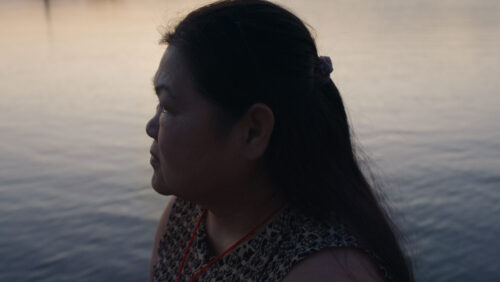
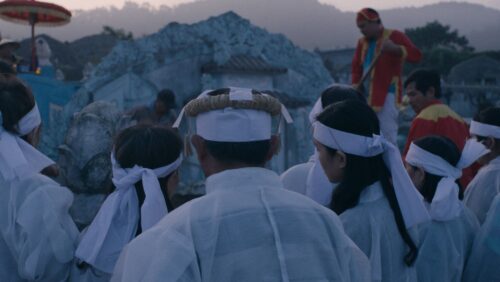
Travelling together to Vietnam, the family embarks on a transformative journey through intergenerational trauma, mental health and deeply layered loss. With profound care, trust and immediacy, Nguyen guides them as they navigate unsealed medical records and long-unspoken questions. How can we grieve if we’ve never been given the chance to be sad? Still haunted by guilt, Nguyen’s father’s search for answers via collective rituals and solitary meanderings soon leads him into the uncanny.
A companion to the award-winning short No Crying at the Dinner Table, Still Night, Burning House marks the feature debut of Vietnamese-Canadian filmmaker Carol Nguyen. A metaphysical poem for complex mourning, Nguyen’s film shows how storytelling can turn grief and regret into healing, hope and a kinship restored.
TW: This film contains discussions of suicide, and the effects on survivors of suicide loss. If you need support services, please call your local Distress Centre. If you need immediate help, please call or text 9-8-8.
Interview with director Carol Nguyen
Interview conducted by Ellen Orme Adams
Could you talk a bit about what sparked this film?
I had always wondered about what exactly happened the day my Uncle Thach passed—why he acted the way he did, how he died. His death was a mystery in my paternal family and also the catalyst for our rupture. Our families stopped talking.
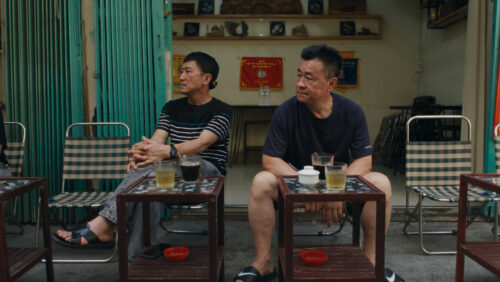
In 2019, I heard my dad speak about my uncle in a very open, intimate and detailed manner for the first time in my film No Crying at the Dinner Table. Hearing my dad’s feelings of guilt and his openness to finally talk about it motivated me to dive deeper and use it as a point of reconciliation in my paternal family. Making Still Night, Burning House gave us a reason and a safe space to come back together. It became the excuse—the ignition—our family needed to reconcile. Additionally, it gave us a reason to take a family trip to Vietnam, where the two generations could connect over untold stories.
I didn’t want to tell another story about “going back home to the motherland” or “war trauma.” I wanted to push the Vietnamese-diaspora narrative, where there are other things that shaped our experience when visiting what we call “the motherland.”
How did the story evolve?
Having never made a feature before, I quickly learned how beautifully messy it can be. I entered the film with a very tight framework: it was to be a story about my Uncle Thach and my dad’s guilt. Very quickly, I came to understand that my preparation could only provide the skeletal focus. The story was writing itself in real time as we were pulled and inspired by serendipitous discoveries during our Vietnam trips. The most beautiful moments in the film were unplanned, including Jennifer’s confession at the end.
What role does silence play in your film’s exploration of mourning?
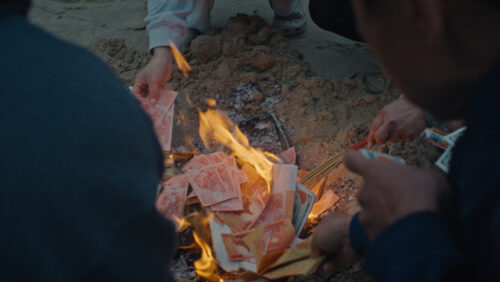
One of my questions when making the film was whether these rituals, and having a certain dependence on them, also prevent us from dealing with our grief in a more communicative and direct way with our loved ones. When praying with an incense stick or burning objects, you never really share what you’re thinking. These rituals give solace, but they also maintain silence. Entering this film, I was like, “Oh, we should all talk, and silence is not good.” Now I see that some people need that gentle solitude.
There are so many contradictions in grief. My dad didn’t believe there was anything after death, and he believes all this joss paper and incense is fake, but he also engages in them. It shows us both the beauty and the absurdity of these created grief aids. Oftentimes our grief latches onto narratives to help us overcome the mystery of what we’ll never have the answers to—and to connect us to a world where our loved ones are now.
Still Night, Burning House includes some surprising—and stunning!—metaphysical elements. What inspired that part of your filmmaking?
I’m fascinated by how storytelling can heal. Incomplete stories can still have an ending. In creating the ghost world in the film, I could physically put my dad into a narrative where he finds some border to the afterlife, something spiritual. I wanted him to find that for himself, a place where he can have a little bit more hope and heal from his guilt.
With the oxen, I didn’t know their narrative role in the ghost world or the film—I just had to follow that instinct. They emerged during the development shoot early in the morning while it was still dark. Juliette, my DOP, and I were wandering the beach when all of a sudden we saw these figures walking down the hill. We couldn’t tell what the animals were, and we wondered: “What is going on? Are we in the afterlife?” We decided to get the camera and shoot. It was so magical, seeing these oxen at the crack of dawn, not knowing what they were doing here on a secluded beach with these carts attached to them. Later, our fixer in Vietnam helped us track down those men and their oxen. These humble creatures, transporting something or someone—they gave us the material to build the ghost world.
How do you approach trust in your filmmaking?
Before we even started filming, I talked with my family to see if they were even open to sharing certain aspects of their life. I showed them that I was there because of a genuine desire to know their story and to create an experience for our family, not just for the film.
There are a lot of problems with extraction in the history of documentary. I wanted to be there for the right reasons, to be present in the way that they need me to be, including when they express their discomfort non-verbally. When I point a camera at someone in an interview, it’s like, “I want to know about you. This is your time to speak. No one’s going to interrupt you. You can tell me where you want to stop, and you can take all the time and space you need.”
How did making this film shift your relationship with your father?
The whole film is a love letter to my dad: telling him I care about him, that I see his pain, that I’ve seen all his pain throughout all these years. While we still struggle with direct communication sometimes, now there is this unspoken knowingness, this understanding, this empathy. We see each other even in the silences.
My dad is the only person who saw the film before we picture locked. I was really nervous. I wanted his approval! After he saw it, he just looked at me and said, “It’s a good film, girl.” And that was enough. He said he had to go home and think about it. Later, he said, “Why do you keep on making sad films? You should try an action movie next time!”
What understanding do you hope audiences will gain about mental illness?
In Vietnamese, we often refer to people with mental illnesses as being “sick.” My family experienced language and cultural barriers that made mental-health education very hard to obtain—from the stigma in the Vietnamese community, to the lexicon that we use around mental illness, to the pressures of being an immigrant.
Knowing that Uncle Thach had a diagnosis of schizophrenia—what that did physiologically and psychologically to him—allows us to extend our empathy. That knowledge helps us deal with the “what ifs” more easily when we know how far we can extend those questions.
I would love it if my film gave people the courage to be able to talk about mental illness and their families a little bit more openly, as scary as that can be. That connection would be very meaningful to me. It would transcend the story itself.
At the opening of the film, your father says, “If I had understood more, it probably wouldn’t have ended that way.” What might Still Night, Burning House teach us about guilt and regret?
It really hit me, too, when he said that. My dad wasn’t very educated about my uncle’s illness. There was so much about his illness that my dad didn’t know—and that he was not able to know.
I can only relate to that journey of self-forgiveness as a second-hand experience of my dad’s, but I think at one point, you have to give yourself grace. The “what ifs” have to settle. You have to find your own answers for why things happened that way. That’s something I’m very interested in with this film, that meaning-making. No one else can tell you what these experiences mean or how they should have turned out. It’s an entirely personal journey.
Trailer
Poster
Excerpts
I still have a lot of fault
Images
Loading...
Download
Loading...
Download
Loading...
Download
Loading...
Download
Loading...

Download
Loading...
Download
Loading...
Download
Loading...
Download
Loading...
Download
Team
Carol Nguyen
Writer/Director
Photo
Photo : Romain Rabasa
Audrey-Ann Dupuis-Pierre
Producer (PORTAGE Films)
Photo
Rob Vroom
Producer
Photo
Photo : NFB
Ariel Nasr
Producer
Photo
Photo : Kiana Hayeri
Sylvain Corbeil
Executive Producer (Metafilms)
Photo
Photo : Vivien Gaumand
Nathalie Cloutier
Executive Producer
Photo
Photo : Valérie Sangin
Bob Moore
Executive Producer (EyeSteelFilm)
Photo
Anh-Duy Vo-Dinh
Executive Producer (Spotlight Production)
Photo
Credits
Written and directed by
Carol Nguyen
With the participation of
Ngoc Nguyen
Jennifer Nguyen
Phán Huê Tang
Jenny Tang
Hoàng Nguyen
Thao Nguyen-Dương
Michelle Nguyen
Nanette Nguyen
Produced by
Audrey-Ann Dupuis-Pierre (PORTAGE Films)
Robert Vroom (NFB)
Ariel Nasr (NFB)
Executive producers
Sylvain Corbeil (Metafilms)
Nathalie Cloutier (NFB)
Bob Moore
Anh Duy Vo Dinh
Cinematographer
Juliette Lossky
Editor
Anouk Deschênes
Sound designer
Marie-Pierre Grenier
Original music by
Arie Verheul Van De Ven
Production managers
Anh Duy Vo Dinh
Stephanie De Bem
Production coordinator
Emilie Serri
Production services – Vietnam
Spotlight Production
Script consultant
Annie St-Pierre
Location managers
Hùng Huynh
Doàn Thanh Thong (Da Sac Màu)
Luu Minh Chien (Da Sac Màu)
Production assistants
Diep Phuong Uyen
Dạt Nguyen
Ho Anh Vu
Dan Thy
Oxen conductors
Chu Tu and the An Bang Locals and Friends
Production manager in development
Louis-Emmanuel Gagné-Brochu
Fixers in development
Huong Jooney Nguyen
Steadicam operator
Tran Doan Nam
Steadicam assistant
Lê Phuoc Thịnh
First assistant camera
Tran Doan Nam
Nguyen Trí
Nguyen Phi Long
Émilie Desmarais
Additional camera – Toronto
Mark Klassen
Sound recordist
Tobias Haynes
Additional sound
Nguyen Huynh Dạt (Tran Linh Sound)
Andrés Solis Barrios
Sara Vada
Music consultant
Olivier Alary
Re-recording mixer
Isabelle Lussier
Sound effects editor
Sandy Pinteus
Foley artist
Nicolas Gagnon
Foley assistant
Francis Dugas
Foley recording engineer
Geoffrey Mitchell
Voice recording engineer
Luc Léger
Image post-production
Cineground
Post-production manager
Nguyen-Anh Nguyen
Director of operations
Aurélie Carpez
Project manager
Claire Bellard
Colorist
Marc Boucrot
Post-production technicians
Thomas Le Lay
Marie Rodriguez
Image post-production
NFB
Technical coordinator
Daniel Lord
Technical support – editing
Pierre Dupont
Albert Kurian
Patrick Trahan
Online editor
Luca Di Gioacchino
Title design & VFX
Mélanie Bouchard
Additional VFX
Manuel Codina
Vietnamese translations
Vy Nguyen
Carol Nguyen
Thao Nguyen-Duong
Cantonese translations
Mickey Lai
Accountants
Mélanie Bouchard
Ian Jaquier
For NFB
Production administrators
Leslie Anne Poyntz
Isabelle Limoges
Line producer
Amanda Roy
Senior production coordinators
Yanis Ait Mohamed
Cheryl Murgatroyd
Senior marketing advisor
Kay Rondonneau
Marketing project manager
Andrea Elalouf
Marketing coordinator
Harmonie Hemming
Lead publicist
Jennifer Mair
Legal counsel
Christian Pitchen
For Metafilms
Administrative manager
Ian Jaquier
Office production assistant
Sophia Chan Kong Randriamalala
Portage Films
Line producer
Jeanne Dupuis
Additional music
“My Way”
Performed by Frank Sinatra
English adaptation by Paul Anka
Based on the melody of “Comme D’habitude”
Lyrics by Gilles Thibaut
Music by Jacques Revaux and Claude François
© Warner Chappell Music France and Jeune Musique
Courtesy of Frank Sinatra Enterprises, LLC
Rights clearance
Tram7
Camera equipment
Cineground
Sound post-production
Bande À Part
NFB
Insurances
Globalex Gestion De Risques Inc
Audit
Demers Baulne
The director would like to thank
My family, my crew, Cô Hau & Chu Nhân, Hugo Garcia, the residents of An Bang, Xá Lợi Temple & Thích Minh Giác, Anh Duy Vo Dinh, Audrey-Ann Dupuis-Pierre, Anouk Deschênes, Patrick Trahan, Simone Ling, Gitte Hansen, Jérôme Bretéché, Mikaël Huot, Judith Cayer, Dan Cross, Aziz Zoromba, Youmna Moacdieh, Miryam Charles, Mila Aung-Twing, Theo Anthony, Ellen Adams, Tâm-Dan Vu, Rosalie Chicoine-Perreault, Swann Dubus, IDFA Project Space, Soup the Dog (AKA Bé Duy), Caspar Newbolt, Bác Liêm — Rest in peace
Produced with the participation of
Téléfilm Canada, SODEC – Société De Développement Des Entreprises Culturelles – Québec, Crédit D’impôt Cinéma Et Télévision – Gestion SODEC, Programme De Crédit D’impôt Pour Production Cinématographique Ou Magnétoscopique Canadienne
Media Relations
-
About Metafilms
Founded in Montreal in 2003, Metafilms aimed to offer young, unusual creators the means to express their vision of cinema and life. Counting now more than fifty films to its credits, Metafilms continues its tradition of rigourously and respectfully seeking out and supporting exceptional creators and their films, which have been shown internationally and have garnered numerous awards in Québec and abroad. Building on its producers’ experience, Metafilms keeps seeking and supporting artists and singular films in fiction as in documentary.
-
About PORTAGE Films
PORTAGE is a Montreal based production company devoted to author driven films and art videos. Ongoing projects are directed by Carol Nguyen, Yasmine Mathurin, Patrick Bossé and Julien Faraut. Damascus Dreams (2021) from Émilie Serri premiered at International Film Festival Rotterdam and won the Fipresci Prize from Festival du Nouveau Cinema.
-
About the NFB
Founded in 1939, the National Film Board of Canada (NFB) is a one-of-a-kind producer, co-producer and distributor of engaging, relevant and innovative documentary and animated films. As a talent incubator, it is one of the world’s leading creative centres. The NFB has enabled Canadians to tell and hear each other’s stories for over eight decades, and its films are a reliable and accessible educational resource. The NFB is also recognized around the world for its expertise in preservation and conservation, and for its rich and vibrant collection of works, which form a pillar of Canada’s cultural heritage. To date, the NFB has produced more than 14,000 works, 7,000 of which can be streamed free of charge at nfb.ca. The NFB and its productions and co-productions have earned over 7,000 awards, including 12 Oscars and an Honorary Academy Award for overall excellence in cinema.