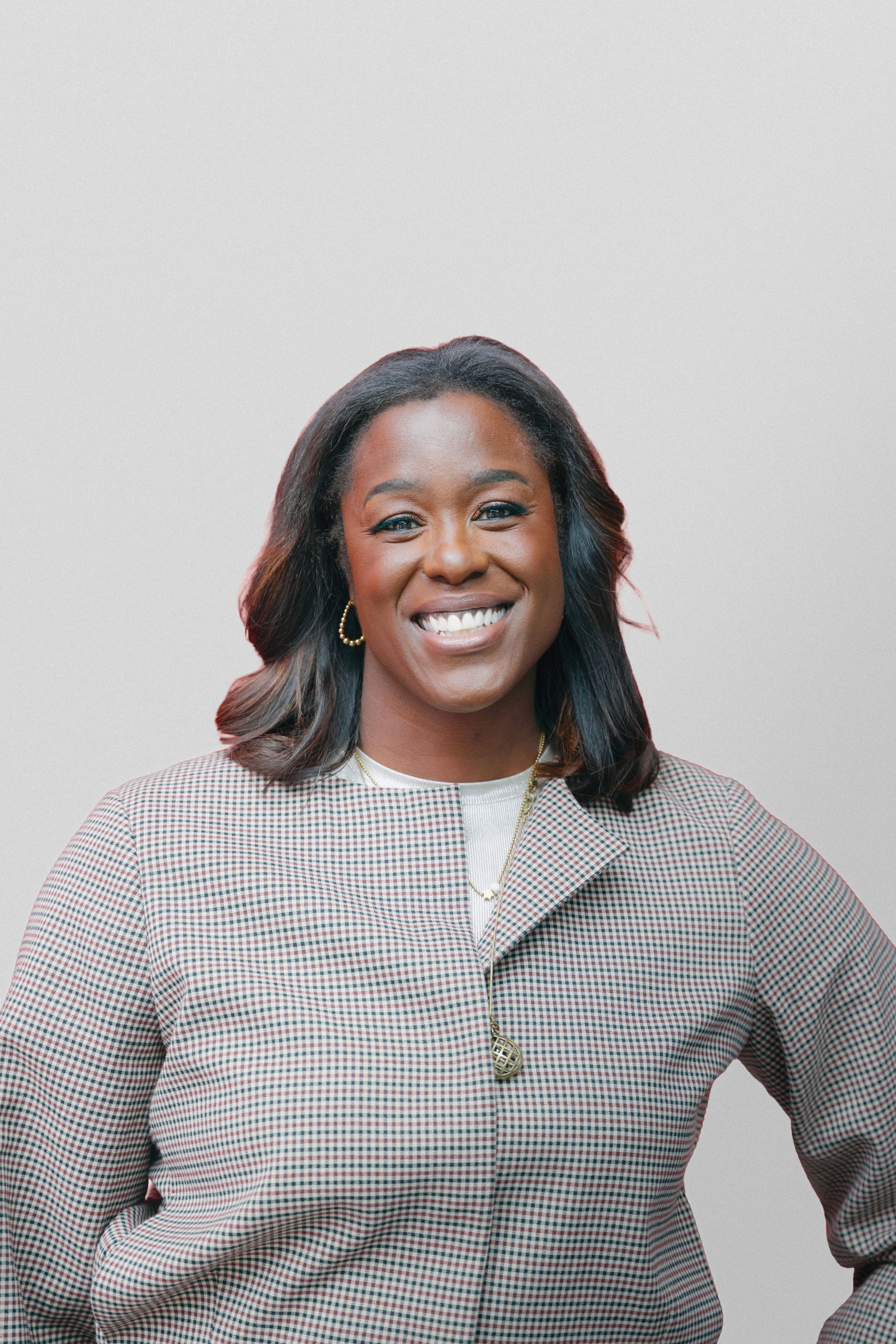
 December 11, 2025 11:45 am
Published by Jimena Romero
December 11, 2025 11:45 am
Published by Jimena Romero
As a child, what did you want to be when you grew up?
I wanted to be an English teacher! When we were very young, my three brothers, my twin sister and I spent our summers in South Carolina and Florida. We were lucky to have been exposed to English at such a young age—especially since, at the time, we lived in Alma, in the (very Francophone) Lac Saint-Jean region. So I wanted to help others master the language or at least not feel embarrassed about speaking English sentences, even if they’re interspersed with “là, là, là!”
I also wanted to be a lawyer, since I often used my words to come to the defence of other people, and deep down I don’t like conflict. However, my father’s best friend hung out with media people, and saw that I had the qualities that would allow me to thrive in that environment. During a dinner, he said that I loved “hanging around the grown-ups at the table” to eavesdrop on conversations so much, that I seemed destined to work in communication.
Did you choose the NFB, or did it choose you?
The NFB chose me!
In 2017, I was working in the provincial Ministry of Economy, Science, and Innovation, headed by Dominique Anglade, and I was leading a roundtable of ministries preparing to launch Quebec’s new digital strategy. The event was being held at the Musée de la Civilisation, the Museum of Civilization in Quebec City. At 4 p.m., on my way back to Montreal, a recruiter called to speak with me about the position of Head of Media Relations at the NFB. My curiosity was definitely piqued! I had worked in many cultural organizations during the early days of my career, and I’d always heard the NFB talked about as a touchstone, and a place where culture and innovation had always gone hand in hand. And, as the daughter of teachers, for me the NFB had been the perfect place to turn to, to feed the curiosity of the five children in our family. So, I prepared as much as I could, to stand out in the competition for the job. The rest is history, as they say!
Now that I’ve told this story, I’m thinking it’s more the case that the NFB and I found each other. Authentic stories have been an important part of my personal journey, so it feels natural to be so at home at the NFB, and to help carry its mandate forward.
How long have you been at the NFB? Tell us about your journey, and your hopes.
I like to say that swimming was my first true love. I swam until I was 21, competing at a high level. That allowed me to travel and meet some extraordinary people, all while continuing my university education. This period of my life had a strong influence on who I am today.
Before I started at the NFB, in January 2018, I had the honour of representing Quebec and Canada as a managing editor, and later a media relations officer for Tourisme Québec. The latter role took me on missions all over the United States and Europe, as well as to China. I was responsible for promoting Canada and Quebec’s wonderful attractions to specialized media from around the world. I even had the pleasure of crossing paths with the NFB’s Lily Robert, who at the time was working in tourism!
Culture is the greatest calling card when it comes to promoting a destination. It also allows us to embrace visitors, and it helps them understand the values of a society.
I have to say that at the time, there were those who thought I was representing destinations much warmer than Quebec. But my tourism promotional events with Bonhomme Carnaval and with the country’s greatest artists left no doubt that I belonged in my position, representing Canada—a country with rich traditions of openness and diversity.
I think major athletic competitions like the Olympic Games are beautiful examples of the marriage between culture and physical achievement. So, you can see how I was drawn to the role of Director of Communications for the 47th FIG Artistic Gymnastics World Championships, held in Montreal in 2017. We welcomed the world’s greatest gymnasts, and I had the opportunity to develop the city’s visual identity as a backdrop. I also had the honour of working with Nadia Comaneci, who had agreed to serve as spokesperson for this great event. My next position, with the Ministry of Economy, Science, and Innovation, saw me working closely with the deputy premier’s office and the government communications secretariat. It was a baptism by fire in the world of politics and international and intergovernmental relations. Communication was key!
As you’ve probably figured out, I love working full throttle on projects and challenges. I thrive on adrenaline in my daily life, having learned how to juggle my career and being a mother to four athletic kids. (You can imagine all the unexpected surprises along the way and the number of Tim Hortons we’ve been to.) At the same time, I’ve been able to surround myself with a village, allowing me to reconcile all these responsibilities. That’s something I’m very proud of. It’s allowed me to be a reliable resource with infectious energy.
I would also add that I am an inclusive leader. I was able to demonstrate that when I was co-director of EDI at the NFB, as well as in my role as Head of Media Relations. In addition, I’m the founder of Frequence, a non-profit organization devoted to celebrating the talents and successes of young people from Black communities in Quebec. And I’m an ambassador for FitSpirit, which encourages teenage girls to take part in physical activity.
In short, I love performance and transparency. Collaboration and working as part of a team allow me to learn about other people’s strengths, and to feel that I can contribute to our reaching the goals we have set. I hope to fulfil my future role as Director of Communications with the greatest possible authenticity, and to lead inspiring projects. I hope to skilfully and responsibly communicate what the NFB and the voices it represents have to say.
What would you say makes the NFB unique?
The NFB is constantly changing, and it has the ability—or, at the very least, a willingness—to adapt. It is a creative environment that moves to the beat of our society and continually takes the pulse of communities, in order to reflect not only what’s best about this country, but also to hold up a mirror and show things we need to improve. And I can’t say enough about the teams that support filmmakers and craftspeople across the country, starting with day one of a project. The people in production and distribution; the team members developing strategies so that projects reach a wide audience. And the media relations team is the voice of these stories, while also shining the spotlight on the experts in front of and behind the camera, and, of course, promoting the NFB, which has a wonderful story in and of itself!
When I look at the NFB, I see an environment with a real interest in telling stories by diverse voices, and that’s one of the things that makes it unique. You know, we work in an organization where stories are at the heart of what we do—both the stories of our colleagues and those told by filmmakers.
Are there any films that have particularly resonated with you or touched you? And if yes, how did they move you?
I’m going to mention one animated film and two documentaries that have resonated with me and my journey. Our collection is so big that it’s hard to choose just one!
Threads very delicately and sensitively explores the act of loving and raising a child, and adoption is one of the story’s themes. The bond is so strong and so well explained in this film by Torill Kove, that it has helped me answer some of my own questions related to my identity. The beauty and simplicity of the images and the movements helped give me confidence in my own role as a mother. My children are now taller than me by several centimetres, but even so, I had to adjust to the idea of their leaving the nest. The film has a soothing effect.
The athlete in me was touched by the story told in the film Mighty Jerome, directed by the late Charles Officer. Harry Jerome’s will and determination were stronger than the systems oppressing him.
And, having three hockey players in the house, I was also moved by the film Ice Breakers, by Sandamini Rankaduwa. It tells the story of the Colored Hockey League, founded in 1895, while also following a young contemporary player named Josh Crooks. It took me back to sitting in the stands as a mother, my heart in my throat, watching my children’s achievements while wanting to also protect them from any words aimed at them that could hurt them, because of the colour of their skin. Imagine this—my oldest was in California recently, celebrating the 90th birthday of Mr. Willie O’Ree, the first Black hockey player in the NHL! These films help contribute to building a world in which we can reach our potential, remember our past and live in harmony together.
Categorised in:
This post was written by Jimena Romero