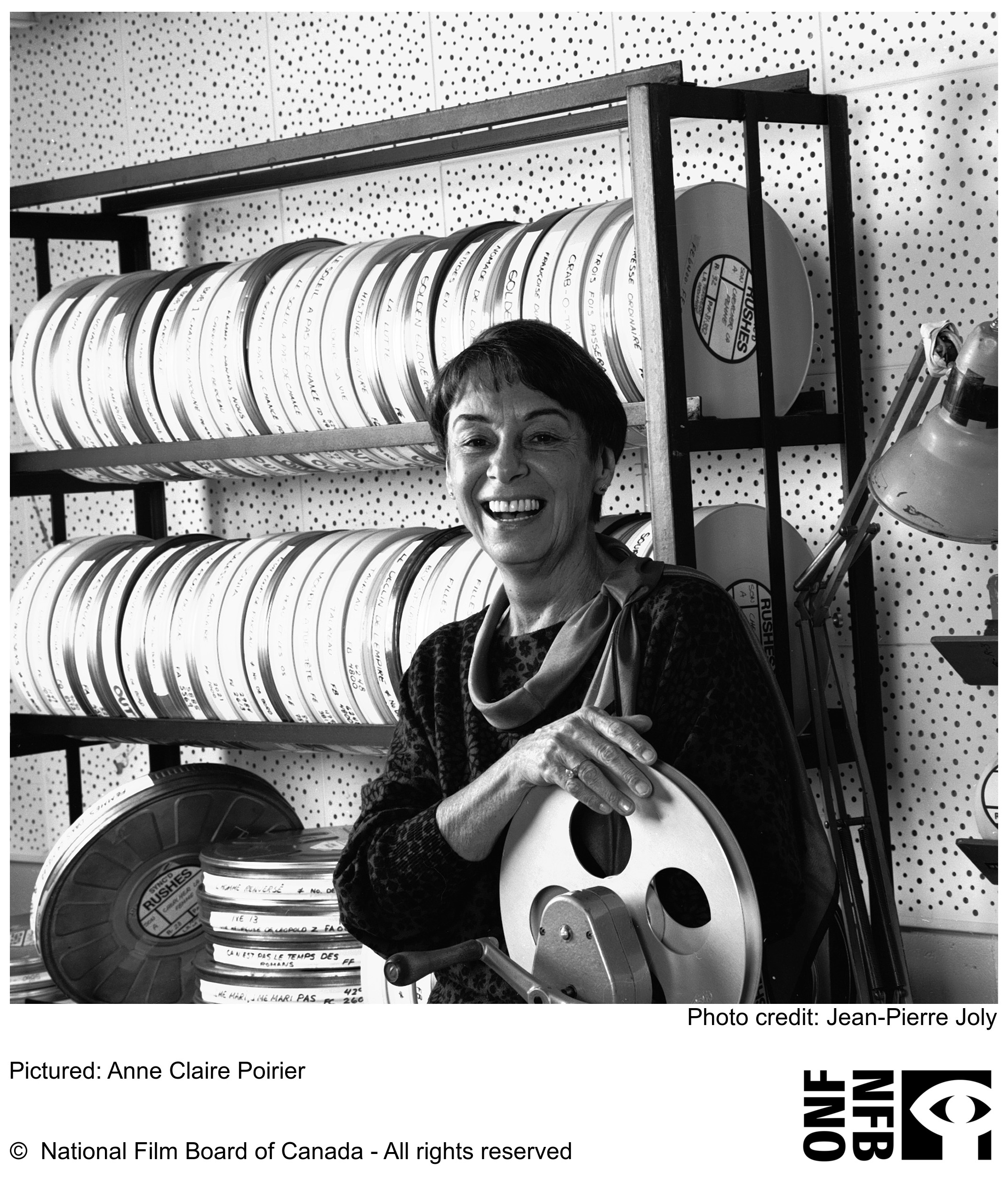
The National Film Board of Canada honours the memory of Anne Claire Poirier, a pioneering Quebec filmmaker
PRESS RELEASE
28/09/2026
September 28, 2026 – Montreal – National Film Board of Canada (NFB)
The National Film Board of Canada (NFB) is greatly saddened to learn of the passing of Anne Claire Poirier, who died on September 27 at the age of 94. As the NFB’s first francophone woman director and producer, she was active from 1960 to 1997, during which time she made some of the most powerful films in Quebec cinema, including Mourir à tue-tête and Tu as crié LET ME GO.
Quote
“Anne Claire Poirier was a true pioneer of our country’s cinema, blazing a trail for Quebec women filmmakers and for feminist cinema. She was the first francophone woman to become a producer and director at the NFB, and the film series she co-created in the 1970s, En tant que femmes, helped firmly establish a place for women in the institution. Her passing is a great loss for both the film industry and Quebec. Our thoughts are with her family, her loved ones, and the entire film community.” — Suzanne Guèvremont, Government Film Commissioner and Chairperson of the NFB
Anne Claire Poirier’s career
- Anne Claire Poirier was born in Saint-Hyacinthe in 1932. After earning a law degree and studying at the Conservatoire d’art dramatique, she began working for Radio-Canada, working successively as an actor, host and theatre critic. She joined the NFB in 1960, starting out in the Versions Services before becoming assistant editor, assistant director and then editor.
- Her drive to direct resulted in one of the first NFB films made by a francophone woman: 30 Minutes, Mister Plummer (1963), a documentary on actor Christopher Plummer. The following year she made La fin des étés, a short fiction film starring Geneviève Bujold, co-directed with Hubert Aquin.
- In 1965, she made the documentary short Les Ludions about the National Theatre School, whose director then was Jean Gascon.
- Made in 1968, her first feature-length film, De mère en fille (Mother-To-Be), chronicled the journey of pregnancy by depicting women’s changing bodies and exploring their fears and emotions. Asking whether it was possible for women to achieve self-realization once they became mothers, the film launched feminist cinema in Quebec.
- In the early 1970s, she and two colleagues, Marthe Blackburn and Jeanne Morazain, fought tirelessly to bring more films “made by women, with women and for women” into the NFB. The result was En tant que femmes, a film series co-created by the three women. Poirier also produced the other works in the series: J’me marie, j’me marie pas (Mireille Dansereau, 1973), Souris, tu m’inquiètes (Aimée Danis, 1973) and Les filles c’est pas pareil (Hélène Girard, 1974).
- Back behind the camera, she made Les filles du Roy (They Called Us “Les Filles du Roy”, 1974), a landmark film that examined the shifting status of women in Quebec and introduced the layered montage and distinctive visual style that would come to characterize Poirier’s later works of fiction.
- Le temps de l’avant (Before the Time Comes, 1975), produced as part of En tant que femmes and perhaps her most classically structured narrative, dealt with abortion. The feature-length drama starring Paule Baillargeon addressed what was a deeply contentious topic, offering a nuanced portrayal of the inner turmoil experienced by the women who must confront the issue.
- From 1975 to 1978, Anne Claire Poirier served as executive producer of the documentary program Société nouvelle and as Studio Head of the NFB’s French production program.
- Her powerful docudrama, Mourir à tue-tête (A Scream from Silence, 1979), examined the issue of individual and mass rape. A composite film, it blended hyperrealism with stylized sequences, juxtaposing archival materials with fictional exchanges between a woman director and her editor as they crafted the film. Mourir à tue-tête caused a sensation and remains her most significant achievement.
- After her fiction feature La quarantaine (1982), she made the TV drama Salut Victor! (1988), starring Jacques Godin and Jean-Louis Roux. The film was co-written with Marthe Blackburn, her collaborator on every project since Les filles du Roy.
- To mark the NFB’s 50th anniversary in 1989, she made Il y a longtemps que je t’aime, a montage that traced how the representation of women on film evolved over the decades at the NFB.
- In 1996, she made Tu as crié LET ME GO, a searing, unflinching examination of the most appalling tragedy a mother can imagine: the addiction and eventual murder, in 1992, of her own daughter, Yanne. The film resonated strongly with audiences and won numerous awards in Canada and abroad, including best Quebec feature from the Association québécoise des critiques de cinéma and a Genie Award.
- She left the NFB in 1997.
- Anne Claire Poirier received many awards and honours throughout her career. In 1985, she was appointed Chevalière de l’Ordre national du Québec, going on to become an Officière in 2008. In 1988, she received the Prix Albert-Tessier, the Quebec government’s highest distinction in cinema. In 2001, she received a Performing Arts Award from the Governor General of Canada, followed by the Jutra Hommage in 2002. She was made an Officer of the Order of Canada in 2003.
- Five English-language versions of her films are available for viewing on nfb.ca.
– 30 –
Media Alert – PDF here.
Version française ici.
Media Relations
-
About the NFB
Founded in 1939, the National Film Board of Canada (NFB) is a one-of-a-kind producer, co-producer and distributor of engaging, relevant and innovative documentary and animated films. As a talent incubator, it is one of the world’s leading creative centres. The NFB has enabled Canadians to tell and hear each other’s stories for over eight decades, and its films are a reliable and accessible educational resource. The NFB is also recognized around the world for its expertise in preservation and conservation, and for its rich and vibrant collection of works, which form a pillar of Canada’s cultural heritage. To date, the NFB has produced more than 14,000 works, 7,000 of which can be streamed free of charge at nfb.ca. The NFB and its productions and co-productions have earned over 7,000 awards, including 12 Oscars and an Honorary Academy Award for overall excellence in cinema.